在新时代重新学习“编程” - #5 读 Pi: The Minimal Agent Within OpenClaw
OpenClaw runs a single embedded agent runtime derived from pi-mono.
在翻阅 OpenClaw 文档时,无意发现其 Agent Runtime 是基于 badlogic/pi-mono 构建。恰好又看到 Armin 写的一篇文章:Pi: The Minimal Agent Within OpenClaw,于是顺着好奇心读了下去。
什么是 Pi
pi-mono 是一个模块化的 AI agent 工具包,涵盖 coding agent CLI、统一 LLM API、TUI & Web UI、Slack bot 等组件。本文聚焦其中的 coding agent —— 原作者最初将其定位为 Claude Code 的替代品。
值得一提的是,项目本身的分层设计相当清晰,下面是各子模块之间的大致依赖关系:
pi-mom
└── pi-coding-agent
    ├── pi-agent-core
    │   └── pi-ai
    └── pi-tui
设计理念
OpenClaw 背后与 Pi 遵循同样的设计理念:既然大模型那么擅长输出文字与代码,不如放手,全权交给它们。
大道至简
项目 Pi 吸引原文作者的两个原因 ♥️:minimal & extensible
1)极简
想起一句名言:“less is more”。举个例子,Pi 的 system prompt 是所有 agent 中最短的:
let prompt = `You are an expert coding assistant operating inside pi, a coding agent harness. You help users by reading files, executing commands, editing code, and writing new files.

Available tools:
${toolsList}

In addition to the tools above, you may have access to other custom tools depending on the project.

Guidelines:
${guidelines}

Pi documentation (read only when the user asks about pi itself, its SDK, extensions, themes, skills, or TUI):
- Main documentation: ${readmePath}
- Additional docs: ${docsPath}
- Examples: ${examplesPath} (extensions, custom tools, SDK)
- When asked about: extensions (docs/extensions.md, examples/extensions/), themes (docs/themes.md), skills (docs/skills.md), prompt templates (docs/prompt-templates.md), TUI components (docs/tui.md), keybindings (docs/keybindings.md), SDK integrations (docs/sdk.md), custom providers (docs/custom-provider.md), adding models (docs/models.md), pi packages (docs/packages.md)
- When working on pi topics, read the docs and examples, and follow .md cross-references before implementing
- Always read pi .md files completely and follow links to related docs (e.g., tui.md for TUI API details)`;
以及仅仅内置了“四大金刚”工具:Read, Write, Edit, Bash
// All available tools (using process.cwd())
export const allTools = {
	read: readTool,
	bash: bashTool,
	edit: editTool,
	write: writeTool,
	grep: grepTool,
	find: findTool,
	ls: lsTool,
};
每个工具对应一段独立的 TypeScript 代码。以 Write 工具为例,逻辑非常清晰:
- 输入:path(文件路径)+ content(完整文件内容)
- 输出:
{ type: "text", text: "Successfully wrote N bytes to <path>" }
2)强大的插件系统
极简内核之上,是一套强大的插件系统:假如将内核比做阳光和光合作用,插件系统便是肥沃广阔的土壤,各种特性由此生根发芽,自由生长,无限延伸(详见下文)。
Pi 没有什么
在理解 Pi 中有什么前,先通过 Pi 中没有什么来理解边界。
Pi 为什么不支持 MCP(Model Context Protocol)?
Pi 的核心理念是代码生代码:当用户想扩展 agent 能力时,不是去找插件、装插件,而是如上所说直接让 agent 自己写代码来解决问题(Agents Built for Agents Building Agents)。所以很自然地,MCP 不在 Pi 自身的实现中。
Pi 有什么
Pi 包含的其他若干重要特性:
- session 与模型解耦:中途可切换任意模型提供商,不依赖某个模型独有的特性。
- session 持久化与热加载:session 不只存储对话,还维护插件状态(持久化到磁盘) -> 支持热重载 -> 最终实现 agent 的不断自我进化:写代码、验证、热加载测试,循环迭代,直到符合预期。
- session 树:Session 以树形结构组织,处理复杂主任务时,可随时开启"干净"的子 Session 处理子任务,避免主 context 爆炸。
实际例子
通过几个具体的例子来说明上面的特性:
1)Hello World(持久化与热重载)
在 Pi 中输入一句话需求:“create a hello world extension and give me a demo of persist state”
Pi 几乎瞬间写好了一个插件,热加载后新增 hello 和 hello-stats 两个命令。从下图可以看到,调用记录已被持久化保存在 session 中:
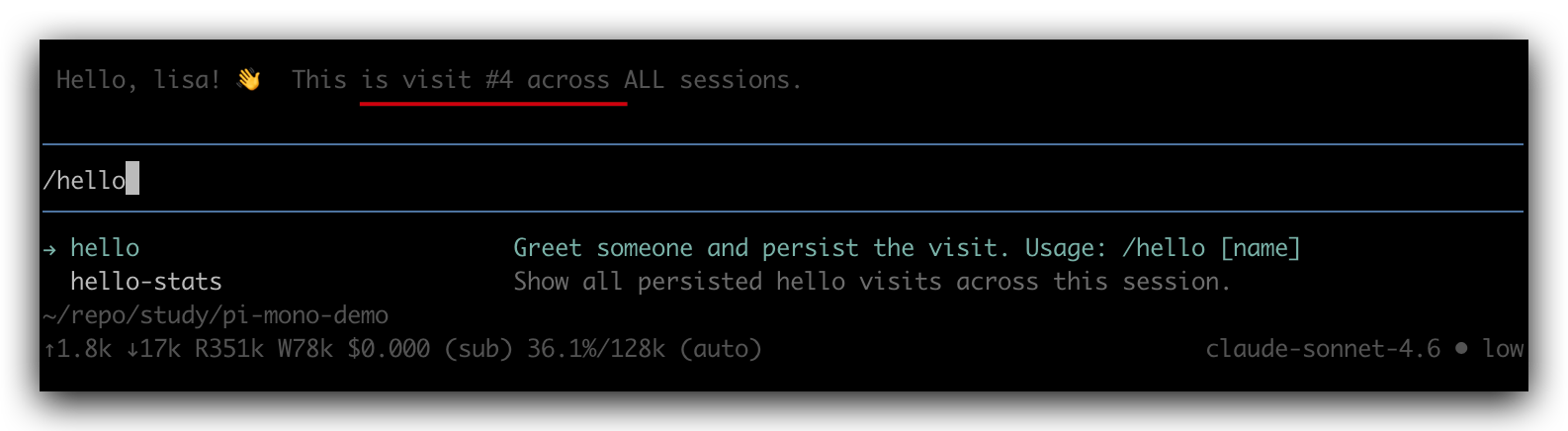
P.S. 持久化信息保存在本地文件(消息类型为 custom):
# ~/.pi/agent/sessions/xxx/<timestamp>_<uuid>.jsonl
{"type":"session","version":3,"id":"44836a7f-47f1-4047-867b-233d495add06","timestamp":"2026-02-23T07:35:17.546Z","cwd":"/Users/henry/repo/study/pi-mono-demo"}
{"type":"model_change","id":"627a6ce7","parentId":null,"timestamp":"2026-02-23T07:35:17.547Z","provider":"github-copilot","modelId":"claude-sonnet-4.6"}
{"type":"thinking_level_change","id":"83b9bc8f","parentId":"627a6ce7","timestamp":"2026-02-23T07:35:17.547Z","thinkingLevel":"low"}
{"type":"custom","customType":"hello-world:visit","data":{"name":"henry","timestamp":1771832189578},"id":"9e85fcde","parentId":"83b9bc8f","timestamp":"2026-02-23T07:36:29.578Z"}
{"type":"custom","customType":"hello-world:visit","data":{"name":"harry","timestamp":1771832197090},"id":"60df2c2a","parentId":"9e85fcde","timestamp":"2026-02-23T07:36:37.090Z"}
{"type":"custom","customType":"hello-world:visit","data":{"name":"lisa","timestamp":1771832325862},"id":"6cfd7dea","parentId":"60df2c2a","timestamp":"2026-02-23T07:38:45.862Z"}
{"type":"message","id":"dbeaec50","parentId":"6cfd7dea","timestamp":"2026-02-23T07:39:18.764Z","message":{"role":"user","content":[{"type":"text","text":"> Hello, lisa! 👋  This is visit #3 across ALL sessions.\n\nwhere do you save this stats? --- which file"}],"timestamp":1771832358749}}
2)代码 review(树形结构)
随着 agent 大量地生出代码,但人类 review 代码的速度已经远远追不上,所以何不直接让 agent 先帮忙 review 一遍代码。
举个简单例子:调用 agent 编写 Python 程序后,单独切出分支,利用一个“中立” agent 进行代码 review,然后切回主分支进行改进。
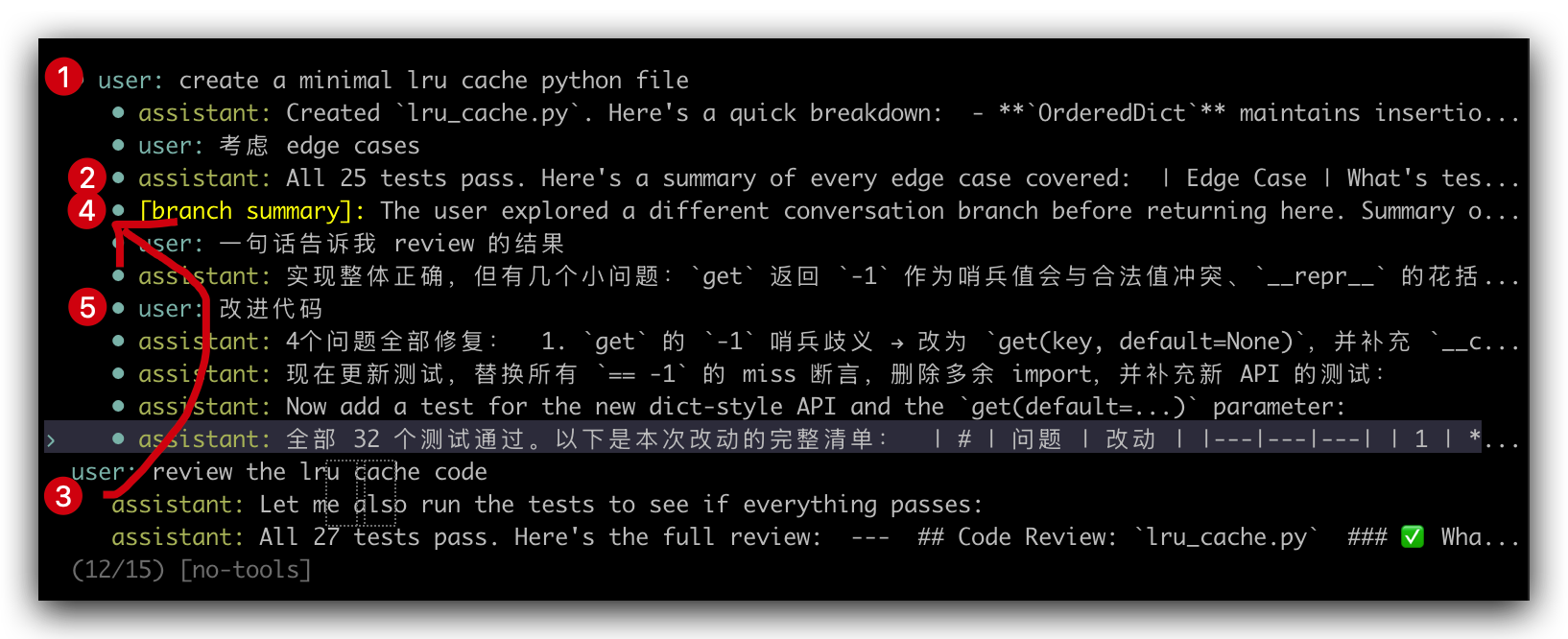
这种设计的好处:1)节省 token:两条线互不干扰,review 的对话不会污染主线的上下文,coding 思考的上下文也不会干扰 review 的过程 2)Review 记录永久保留:随时可以用 /tree 回去查看当时的完整 findings,或者在不同时间点对同一份代码开多个 review 分支做对比。
# 普通 session(线性):
消息1 → 消息2 → 消息3 → 消息4 → ...

# Pi session(树形):
消息1 → 消息2 → 消息3
                    ├── 分支A:写代码
                    │       ↓
                    ├── 分支B:review代码(全新视角)
                    │       ↓
                    └── 总结并回到消息3,带着修复继续
个人感受
- 代码生代码:上面这些例子,都是 agent 从零开始,根据用户的一句话自己写出想要的东西。当模型的能力快速变强,编程的模式也在快速发展,而 Pi 代码生代码(Software Building Software)的设计哲学,似乎更符合未来。
- 学习模式改变:编程之外,学习新知识的模式也发生了变化。从依赖搜索引擎、人工筛选整理、反复消化吸收,变为纯 AI 对话。
- AI 时代的 VIM:Pi 于我而言,有点像是 AI 时代的 VIM 替代品,用着用着,便有了人机合一的感觉。
参考
- https://lucumr.pocoo.org/2026/1/31/pi/
- https://github.com/badlogic/pi-mono/blob/main/packages/coding-agent/docs/extensions.md
- https://github.com/mitsuhiko/agent-stuff/tree/main/pi-extensions
- https://mariozechner.at/posts/2025-11-02-what-if-you-dont-need-mcp/
- https://github.com/badlogic/pi-mono/tree/main/packages/coding-agent#philosophy