读 Python behind the scenes #2: how the CPython compiler works
上一章中,我们讨论了 Python 代码运行的三部曲。这一章我们将进一步深入理解 python 编译器是如何生产出最终执行所需的 code object(bytecode)。
https://tenthousandmeters.com/blog/python-behind-the-scenes-2-how-the-cpython-compiler-works/
什么是 CPython compiler?
传统编译器(例如 LLVM),目标是同时支持多种源代码,通过同一套 intermediate representation (IR) 解耦后,编译为不同指令集的机器码:
   C/C++ -> Clang frontend  ┐
   Rust  -> rustc frontend  ├──> LLVM IR -> x86/ARM/RISC-V machine code
   Swift -> Swift frontend  ┘
而 CPython 编译器,只需要处理 Python 一种源代码,但还是按照传统的「三阶段」进行设计:
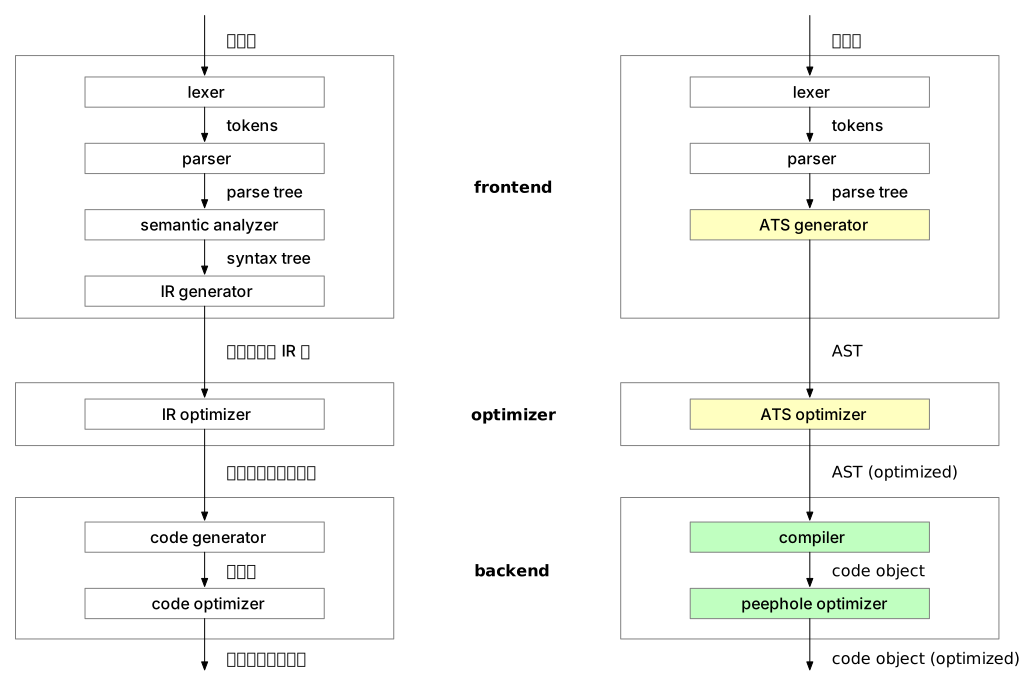
传统编译器 vs CPython 编译器
总览
上图中编译器由两大块组成(对应接下来两章节):
- 源代码 -> AST:frontend 接收 Python 代码生成 AST(核心是 parser)
- AST -> bytecode:backend 进而将 AST 转化为 code object(bytecode 保存在 code object 的一个属性中)。所以从某种意义上来说,CPython 编译器又可以称之为“code object 生成器”。
举个更有体感的例子:下面常见的 Python 代码语法错误异常,就是由 front 中的 parser,在处理时抛出的(「语法」具体是什么将在下文详细展开):
x = y = = 12
        ^
SyntaxError: invalid syntax
源代码 -> AST
https://github.com/we-like-parsers/pegen_experiments https://www.youtube.com/watch?v=QppWTvh7_sI
⚠️ 原文过于晦涩难懂.. 尝试配合使用 Guido 写的 ToyParser 理解并解释如何将 源代码 转化为 AST 的。
1 旧 parser
😂Guido 描述 pgen(旧 parser) 的另一个优点:由于它本身的各种限制,成为了很好拒绝部分新特性的“借口” — 你希望引入的语法用 pgen 太难实现了 —— 是否也意味着对于普通人太那理解了。
前文提到从 Python3.9 开始,CPython 中同时存在两个 parser(下文简单称之为 新 parser & 旧 parser)。CPython 默认使用新 parser,当然也可以通过 -X oldparser 参数开启旧 parser。但从 Python3.10 开始,旧 parser 被完全的移除。
(略)
2 tokenizer
Python 是一门复杂的语言,但语法相对简单,仅包含 63 个 TOKEN(Grammar/Tokens)。
下面的输出(tokens)就是 parser 眼中的代码:
- tokenizer 每次读一个字符,并尝试匹配一个完整 token(w → wh → whi → whil → while)。
- parser 每次向 tokenizer 请求并处理一个 token。
def x_plus(x):
    if x >= 0:
        return x
    return 0

$ python -m tokenize example2.py
0,0-0,0:            ENCODING       'utf-8'
1,0-1,3:            NAME           'def'
1,4-1,10:           NAME           'x_plus'
1,10-1,11:          OP             '('
1,11-1,12:          NAME           'x'
1,12-1,13:          OP             ')'
1,13-1,14:          OP             ':'
1,14-1,15:          NEWLINE        '\n'
2,0-2,4:            INDENT         '    '
2,4-2,6:            NAME           'if'
...
P.S. tokenizer 是如何处理不同的编码呢?首先通过 io 模块检测编码类型,统一把源码解析为 unicode 文本。但 CPython 内部,最终都会统一转成 UTF-8 处理。
P.S. tokenizer 会将缩进转化为 INDENT/DEDENT(不包括例如多行括号内部的缩进),方便下个阶段 parser 处理(利用缩进栈维护上下文)。
3 新 parser
新的 parser 对应的新的语法:Parsing Expression Grammar (PEG)。PEG 最早由 Bryan Ford 在 2004 年提出,作为一种描述语言的工具,可以根据语法描述,自动生成 parser 代码。
但在 CPython 中,Guido 重头实现 parser generator 的逻辑(号称 just for fun)。
                                                tokens
                                                  |
                                                  v
PEG grammar ---> [ parser generator ] ---> [ Syntax parser ]
                                                  |
                                                  v
                                                 tree
3.1 PEG grammar
简易版语法解释👇:
- 每行代表一条语法规则(名字:内容):
|表示多个备选项。例如第一行statement可以是赋值语句、表达式语句或if语句。- expr 表达式支持加减法:
x+1,x-1,x+y-2,… - 同时支持左递归:
expr '+' term | expr '-' term | termx - y - z->(x - y) - z。
- expr 表达式支持加减法:
NAME和NUMBER是提前定义好的 token;单引号'+'和'if'是 grammar 中的 literal token,参考 cpython/Grammar/Tokens。
statement: assignment | expr | if_statement
expr: expr '+' term | expr '-' term | term
term: term '*' atom | term '/' atom | atom
atom: NAME | NUMBER | '(' expr ')'
assignment: target '=' expr
target: NAME
if_statement: 'if' expr ':' statement
挑战:在解析语法 answer = 42 时,是逐个 TOKEN 解析的(answer -> = -> 42),但在下面的例子中,解析到第一个 token answer 时,无法判断是 assignment 还是 expr。所以 Guido 引入了 infinite lookahead buffer,也就是说不用只看一个 token 做决定,可以先尝试一条分支(无限个 token),失败了就回退原始位置,再试另一条(backtracking)。
class Tokenizer:
    def __init__(self, tokengen):
        """Call with tokenize.generate_tokens(...)."""
        self.tokengen = tokengen
        self.tokens = []
        self.pos = 0
    def mark(self):
        return self.pos
    def reset(self, pos):
        self.pos = pos
    def get_token(self):
        token = self.peek_token()
        self.pos += 1
        return token
    def peek_token(self):
        if self.pos == len(self.tokens):
            self.tokens.append(next(self.tokengen))
        return self.tokens[self.pos]
tradeoff:30 年前内存非常珍贵,但现在我们选择在解析前将整个程序加载到内存中,挣脱内存的束缚,最终让一切变得更加简单。
P.S. 新 parser 的生成流程中,跳过了 parse tree,直接生成 AST 树。
- 旧 parser:tokens -> (old parser) -> parse tree -> AST -> bytecode
- 新 parser:tokens -> (PEG parser) -> AST -> bytecode
3.2 parser generator
基于上面的三个挑战和思路,Guido 决定自己用 python 实现了一套 PEG 语法解析的逻辑(输入语法 grammar,自动输出生成 parser)。
分解为两步:
3.2.1 语法 -> 结构化数据
[
  Rule('statement', [['assignment'], ['expr'], ['if_statement']]),
  Rule('expr', [['expr', "'+'", 'term'],
                ['expr', "'-'", 'term'],
                ['term']]),
  ...
]
3.2.2 结构化数据 -> parser
最简陋版本的 parser generator:
def generate_parser_class(rules):
    print(f"class ToyParser(Parser):")
    for rule in rules:
        print()
        print(f"    @memoize")
        print(f"    def {rule.name}(self):")
        print(f"        pos = self.mark()")
        for alt in rule.alts:
            items = []
            print(f"        if (True")
            for item in alt:
                if item[0] in ('"', "'"):
                    print(f"            and self.expect({item})")
                else:
                    var = item.lower()
                    if var in items:
                        var += str(len(items))
                    items.append(var)
                    if item.isupper():
                        print("            " +
                              f"and ({var} := self.expect({item}))")
                    else:
                        print(f"            " +
                              f"and ({var} := self.{item}())")
            print(f"        ):")
            print(f"            " +
              f"return Node({rule.name!r}, [{', '.join(items)}])")
            print(f"        self.reset(pos)")
        print(f"        return None")
3.3 parser
从下面代码中,不难理解自顶向下,依次解析匹配候选项(通过无限缓冲区持久化复位):
self.mark()->token.mark():记录当前的索引位置,开始匹配self.reset()->token.reset():匹配失败,回到刚刚标记的位置
class ToyParser(Parser):
    @memoize
    def statement(self):
        pos = self.mark()
        if (True
            and (assignment := self.assignment())
        ):
            return Node('statement', [assignment])
        self.reset(pos)
        if (True
            and (expr := self.expr())
        ):
            return Node('statement', [expr])
        self.reset(pos)
        if (True
            and (if_statement := self.if_statement())
        ):
            return Node('statement', [if_statement])
        self.reset(pos)
        return None
    ...
左递归:
'+'->self.expect('+'),代表 尝试读取一个+token,失败会返回None并进入下一个分支进行匹配。expr->(expr := self.expr()),尝试解析一个表达式(递归)。
@memoize
def expr(self):
    pos = self.mark()
    if (True
        and (term := self.term())
        and self.expect('+')
        and (expr := self.expr())
    ):
        return Node('expr', [term, expr])
⚠️注意:普通 PEG parser 无法直接处理左递归(会无限递归 → stack overflow),传统做法是把它改写成等价的迭代形式:
- grammar:
expr: expr '+' term | expr '-' term | term - 改写后:
expr: term ('+' term)*
而 Guido 在新 parser generator 中实现了 @memoize_left_rec,让我们可以直接按自然的左递归写法去写 grammar,由装饰器在运行时处理左递归。
@memoize_left_rec # 修改了缓存装饰器避免无限 overflow
def expr(self):
   pos = self.mark()
   if (True
       and (expr := self.expr())   # 左递归:(1+2)+3
       and self.expect('+')
       and (term := self.term())
   ):
       return Node('expr', [expr, term])
4 AST
语法抽象树 Abstract syntax tree (AST) 使用树状结构:
- 作为源代码的一种高级表示,抽象隐藏了很多非必要的信息,例如代码缩进、标点符号,以及其他语法特性。
- AST 的主要受益者是编译器:让编译器基于结构化的表示,更加简单地生存字节码。除了编译器,其他 Python 工具也会使用 AST:例如 pytest 会修改 AST,以便于在
AssertionError抛出时提供更多信息;Bandit 通过分析 AST 来发现 Python 代码中常见的安全问题。
下面是用 python 标准 ast 模块生成的示例:
# 1 + 2 + 3

# 递归判断:
expr
├── expr
│   ├── expr
│   │   └── term 1
│   └── term 2
└── term 3

# 真实 AST 树(整个 module 作为一个 code block)
➜  tmp python3.12 -m ast xxx.py
Module(
   body=[
      Expr(
         value=BinOp(
            left=BinOp(
               left=Constant(value=1),
               op=Add(),
               right=Constant(value=2)),
            op=Add(),
            right=Constant(value=3)))],
   type_ignores=[])
NUMBER token 的文本值是如何被转化为数字的?在 ToyParser 示例中,grammar action 可以直接计算结果;也是 CPython 中构造 AST 节点的主力军。
start: expr NEWLINE { expr }
expr: expr '+' term { expr + term }
    | expr '-' term { expr - term }
    | term { term }
term: NUMBER { float(number.string) }
5 AST optimization
AST optimizer 层在 CPython 3.7 引入。举个例子:
# 优化前
Module
└── Expr
   └── BinOp(Add)
       ├── BinOp(Add)
       │   ├── Constant(1)
       │   └── Constant(2)
       └── Constant(3)

# 优化后(产量折叠 - 避免在运行时重新计算)
Module
└── Expr
   └── Constant(6)
AST -> bytecode
CPython 不认识 AST,需要将它转化为 bytecode 后,再通过 VM 执行。
以赋值语句为例(x = 1),它对应的 AST 节点为 Assign(targets=[Name(id='x', ctx=Store())], value=Constant(value=1))。如果将它转化为 bytecode,我们需要 LOAD_CONST 指令存常量,用 STORE_NAME 指令存变量名。但问题在于,赋值时变量 x 无法判断类型,是方法内的局部变量(STORE_FAST),全局变量(STORE_GLOBAL),还是闭包变量(LOAD_DEREF / STORE_DEREF)?
symbol table
为了解决这个问题,需在在编译前,维护好 symbol table:
- 一个
symtable对应多个_symtable_entry - 每个
_symtable_entry包含 code block 的名字和类型(module, class or function),以及其中变量的作用域和用法。
typedef struct _symtable_entry {
    PyObject_HEAD
    PyObject *ste_id;        /* int: key in ste_table->st_blocks */
    PyObject *ste_symbols;   /* dict: variable names to flags */
    PyObject *ste_name;      /* string: name of current block */
    PyObject *ste_varnames;  /* list of function parameters */
    PyObject *ste_children;  /* list of child blocks */
    PyObject *ste_directives;/* locations of global and nonlocal statements */
    _Py_block_ty ste_type;   /* module, class, or function */
    int ste_nested;      /* true if block is nested */
    unsigned ste_free : 1;        /* true if block has free variables */
    unsigned ste_child_free : 1;  /* true if a child block has free vars,
                                     including free refs to globals */
    unsigned ste_generator : 1;   /* true if namespace is a generator */
    unsigned ste_coroutine : 1;   /* true if namespace is a coroutine */
    unsigned ste_comprehension : 1; /* true if namespace is a list comprehension */
    unsigned ste_varargs : 1;     /* true if block has varargs */
    unsigned ste_varkeywords : 1; /* true if block has varkeywords */
    unsigned ste_returns_value : 1;  /* true if namespace uses return with
                                        an argument */
    unsigned ste_needs_class_closure : 1; /* for class scopes, true if a
                                             closure over __class__
                                             should be created */
    unsigned ste_comp_iter_target : 1; /* true if visiting comprehension target */
    int ste_comp_iter_expr; /* non-zero if visiting a comprehension range expression */
    int ste_lineno;          /* first line of block */
    int ste_col_offset;      /* offset of first line of block */
    int ste_opt_lineno;      /* lineno of last exec or import * */
    int ste_opt_col_offset;  /* offset of last exec or import * */
    struct symtable *ste_table;
} PySTEntryObject;
看一个实际的例子:
# example3.py
def func(x):
    lc = [x+i for i in range(10)]
    return lc
>>> from symtable import symtable
>>> f = open('example3.py')
>>> st = symtable(f.read(), 'example3.py', 'exec') # module's symtable entry
>>>
>>> st.get_children()[1].get_symbols()
[
    <symbol 'x': LOCAL, DEF_PARAM>,
    <symbol 'lc': LOCAL, USE|DEF_LOCAL>,
    <symbol 'range': GLOBAL_IMPLICIT, USE>, #
    <symbol 'i': LOCAL, USE|DEF_LOCAL|DEF_COMP_ITER>
]
所以 symbol table 是什么时候生成的呢? AST 生成完毕后,会遍历树,并为每一个 code block 生成一个 symbol table entry。
一个有趣的极端例子:在第一次遍历 AST 树时,无法判断 nested 中的 x 是什么类型的变量。为了解决这个问题,CPython 做了第二次的 AST 树遍历。
def top():
    def nested():
        return x + 1
    x = 10
    ...
一个新的问题:下面代码中,if 分叉生成的 bytecode 是线性,最终通过跳转来处理 else 逻辑。
if x == 0 or x > 17:
    y = True
else:
    y = False
...

If(
  test=BoolOp(...),
  body=[...],
  orelse=[...]
)
但是,在生成 POP_JUMP_IF_FALSE 时,else 分支的 code 还没生成,如何知道需要跳转的未来的 index 呢?
1           0 LOAD_NAME                0 (x)
            2 LOAD_CONST               0 (0)
            4 COMPARE_OP               2 (==)
            6 POP_JUMP_IF_TRUE        16
            8 LOAD_NAME                0 (x)
           10 LOAD_CONST               1 (17)
           12 COMPARE_OP               4 (>)
           14 POP_JUMP_IF_FALSE       22     # 这里

2     >>   16 LOAD_CONST               2 (True)
           18 STORE_NAME               1 (y)
           20 JUMP_FORWARD             4 (to 26)

4     >>   22 LOAD_CONST               3 (False)
           24 STORE_NAME               1 (y)
5     >>   26 ...
basic blocks
为了解决这个问题,编译的时候,会将代码拆分为多个小块(block)并维护跳转关系。直到每个块的大小都生成好后,再计算 bytecode 真实的偏移量。
这里代码块的数据结构就叫做 basic blocks:
b_list指向所有 blocks。b_next表示正常顺序执行时进入的下一个 block;条件/无条件跳转目标由具体跳转指令维护。
typedef struct basicblock_ {
    /* Each basicblock in a compilation unit is linked via b_list in the
       reverse order that the block are allocated.  b_list points to the next
       block, not to be confused with b_next, which is next by control flow. */
    struct basicblock_ *b_list;
    /* number of instructions used */
    int b_iused;
    /* length of instruction array (b_instr) */
    int b_ialloc;
    /* pointer to an array of instructions, initially NULL */
    struct instr *b_instr;
    /* If b_next is non-NULL, it is a pointer to the next
       block reached by normal control flow. */
    struct basicblock_ *b_next;
    /* b_seen is used to perform a DFS of basicblocks. */
    unsigned b_seen : 1;
    /* b_return is true if a RETURN_VALUE opcode is inserted. */
    unsigned b_return : 1;
    /* depth of stack upon entry of block, computed by stackdepth() */
    int b_startdepth;
    /* instruction offset for block, computed by assemble_jump_offsets() */
    int b_offset;
} basicblock;
frame blocks
另一个问题:遇到 continue 和 break 时,应该跳到哪个 basic block 呢?
引入 frame block(每个类型,对应一种特殊的 basicblock,在外面包了一层,负责 finally “擦屁股”):
enum fblocktype { WHILE_LOOP, FOR_LOOP, EXCEPT, FINALLY_TRY, FINALLY_END,
                  WITH, ASYNC_WITH, HANDLER_CLEANUP, POP_VALUE };

struct fblockinfo {
    enum fblocktype fb_type;
    basicblock *fb_block;
    /* (optional) type-specific exit or cleanup block */
    basicblock *fb_exit;
    /* (optional) additional information required for unwinding */
    void *fb_datum;
};
字节码优化
删除了冗余指令,例如永远也执行不到的语句:
def foo():
    return bar
    print("hi")
总结
流水线小结:
# 阶段1:
source code  ->  tokenizer -> tokens
                                 |
                                 v
grammer -> parser generator -> parser -> AST -> AST (optimized)

# 阶段2:
AST -> symbol table
            |
            v
     basic blocks  -> assembler -> code object [bytecode + meta]
        (graph)                      (linear)
时间有限,浅浅的带过 CPython 编译的流水线,如果你感兴趣可以进一步深入了解以下话题:
- 前端(源代码 → AST):
@memoizevs@memoize_left_rec:packrat parser 如何用 memoization 把指数级回溯变成线性?Guido 的「seed parsing / grow the seed」算法又是怎么让 PEG 直接支持左递归的? - 前端(源代码 → AST):PEG grammar 中的
{ ... }action 在 CPython 里是如何串起 AST 节点构造的?参考Grammar/python.gram。 - 后端(AST → bytecode):frame block 是怎么实现
break/continue/return在try/finally/with中的正确语义(unwind 顺序、cleanup)?
参考
- https://tenthousandmeters.com/blog/python-behind-the-scenes-2-how-the-cpython-compiler-works/
- https://aosabook.org/en/v1/llvm.html
- https://en.wikipedia.org/wiki/Compilers:_Principles,_Techniques,_and_Tools
- https://github.com/we-like-parsers/pegen_experiments
- https://github.com/python/cpython/blob/3.9/Tools/peg_generator/pegen/parser_generator.py
- https://eli.thegreenplace.net/tag/python-internals
Read more
- 读 Python behind the scenes #5: how variables are implemented in CPython
- 读 Python behind the scenes #4: how Python bytecode is executed
- 读 Python behind the scenes #3: stepping through the CPython source code
- 读 Python behind the scenes #2: how the CPython compiler works
- 读 Python behind the scenes #1: how the CPython VM works